
Booknote: “Paradise Lost: A Biography” by Alan Jacobs

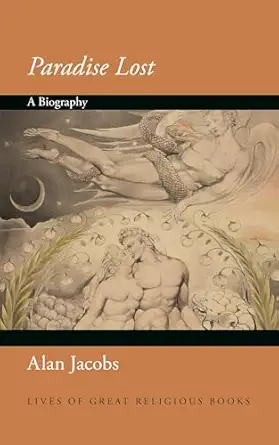

Paradise Lost: A Biography, by Alan Jacobs. Princeton University Press, 2025, 203 pages, $24.95.
Nothing is easy about Paradise Lost (PL)—and especially not for contemporary readers.
First, the poem itself presents problems. Long gone are the days when it could be assumed that educated Americans had read—or at least dipped into—the epic poetry of Homer, Virgil, and Milton. Paradise Lost contains over ten thousand lines of blank verse and is full of references to Greek and Latin literature, cosmological speculations, an imaginative recasting of the first three chapters of Genesis, a tour of the unfolding biblical history of redemption, and no small amount of theological polemics. Content alone is enough to deter many readers. Still others make it to the finish line wondering if their perseverance was worth it. As Mark Twain wryly noted, Paradise Lost meets one definition of a classic: “Something that everybody wants to have read and nobody wants to read” (126).
There are problems with the poem. There are also problems with the poet. At least in his own day, Milton found himself on “the wrong side of history.” His support of the parliamentary army, defense of regicide, and service in Cromwell’s government were all, by the Stuart restoration, lost causes.
If national tumult and civil war were not enough, life in the poet’s home was turbulent. His first wife left him, leading him to write a brief for divorce (she eventually returned). If historical accounts are reliable, three daughters found him to be a domestic tyrant.
Problems with poet and poem acknowledged, Paradise Lost remains a classic of English literature. And Alan Jacob’s Paradise Lost: A Biography provides ample motivation to take up and read or reread the great work. A volume in the Lives of Great Religious Books series, its purpose “is to provide a biography of the poem—that is, to narrate how it has lived over the centuries since its composition.” To make this project manageable in less than two hundred pages, Jacobs confines himself to three hotly contested areas in Milton studies: government, sexual politics, and theology proper (29–30). One need not proceed far in his whirlwind history of the poem’s interpretation before coming to agree with him that “almost every statement one might make about Paradise Lost, even the most apparently anodyne, may be debated.” (71)
